Showing posts with label ^ Books. Show all posts

Thursday, January 20, 2022

Book: "In the Blast Zone: Catastrophe and Renewal on Mount St. Helens"


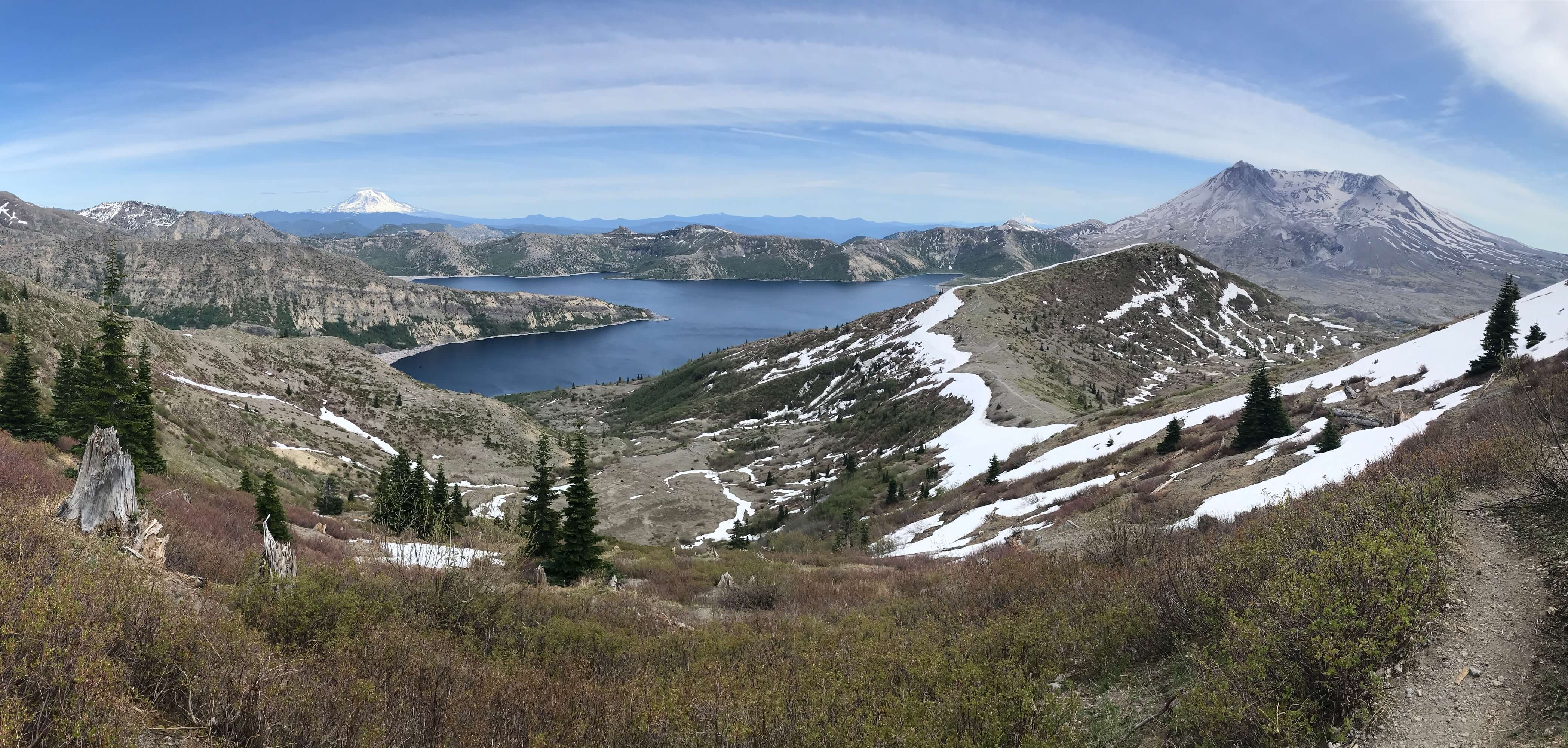
While daydreaming about my next trip to and around Mt St Helens, I’ve been reading this book. It’s a “collection of poetry and essays” that emerged “from a July 2005 camping trip and educational event at MSH […] that brought together many of the leading writers and ecologists of the American West.”

The “novelists, ecologists, poets, natural historians, philosophers, and geologists” who participated in the 2005 foray included:
- Photographer Gary Braasch, (link)
- Author John Calderazzo, (link)
- Writer & calligrapher Christine Colasurdo, (link)
- Research ecologist Charlie Crisafulli, (link)
- Author John Daniel, (link)
- Research scientist Jerry Franklin, (link)
- Poet Charles Goodrich, (link)
- Professor of ecology Robin Wall Kimmerer, (link)
- Author Ursula K. Le Guin, (link)
- Poet Tim McNulty, (link)
- Author Kathleen Dean Moore, (link)
- Forestry researcher Nalini Nadkarni, (link)
- Naturalist Robert Michael Pyle, (link)
- Professor of English Scott Russell Sanders, (link)
- Aquatic scientist Jim Sedell, (link)
- Author Gary Snyder, (link)
- Author Kim Stafford, (link)
- Lover of volcanoes and writer Fred Swanson, (link)
- Researcher and ecology professor Tony Vogt, (link)
- Writer, artist, and naturalist Ann Zwinger, (link)
- Naturalist and writer Susan Zwinger, (link)

Of all the essays, the chapter by James Sedell resonated with how I'm feeling personally, at this point in time:

"In an article on MacArthur's work, Stephen Fretwell wrote, 'In all research reporting, over-attention to detail can obscure the spirit of curiosity and wonder upon which good, basic research depends. MacArthur's work ... makes inexcusable the report that is deadly dull, but otherwise correct. Better to spend (as MacArthur did) one's time and energy being interesting; if something has to be sacrificed, let it be exactness. Clearly, one can contribute as much with such an approach.' I paraphrased this as a guiding mantra for scientific research: What is the storyline?" Pg. 86
“Going to the volcano with those writers and scientists and other volcano friends helped me reconnect with my own sense of purpose—to share the passion I feel for science […]! I thank Mount St. Helens for stepping into my life at key junctures to bring this purpose and passion into sharp focus.” Pg. 89

While some of the essays are written by scientists and go into some detail about the species of flora and fauna that inhibited the "blast zone" before and after the 1980 eruptions, is the essays and poems about how the writers felt about the area, describing a "loss" and "destruction", many are quick to point out that this "negative" terminology is not accurate in fact and sentiment. 

The writers challenge with their own assumptions & first impressions and are learning to see the "event" and changes after as allegory for recovery, resiliency, and finding purpose when it's not obvious, informing how we can better react to big changes.

“A man turning sixty may lose perspective on time, seeing all change as loss, counting his aches as if they were worry beads, anticipating the chill wind of his last hour instead of breathing in the present moment. And so, to regain his grip on time, to console himself for loss, and to remind himself of the great story in which he is taking part, he may consult with rocks.” - from “Two Stones” by Scott Russell Sanders, Pg. 92

---

IG Post about the book (original text for this post): https://www.instagram.com/p/CY7JT16PzJC/

Saturday, August 21, 2021

Book: Zen and the Art of Motorcycle Maintenance, thoughts about road trips & hikes

Goodreads: Zen and the Art of Motorcycle Maintenance

This book really change my ideas about road trips and hiking/climbing. While the title implies it's a book about fixing & tuning bikes, the subtitle "Inquiry into Values" suggests something that reside within. How we approach something, and why.

What I like about the structure of the book is that it mimic what the narrator is experiencing sort of in real time, weaving between the tangible reality of a road trip and those long periods of meditation (because you can't really talk on a motorcycle).

I've also experienced that feeling of déjà vu when traveling through places I visited as a kid or as a young adult. Lifetimes ago. Phaedrus was here. My IG handle is @pha3drus (cuz the regular spelling was taken).

Within the book there are some great quotes than have echoed in my mind since I first read them.

"We want to make good time, but for us now this is measured with emphasis on “good” rather than “time” and when you make that shift in emphasis the whole approach changes."

When you are so focused on getting from Point A to Point B, you miss all the cool things in between. This is common wisdom and a well-known trope but it's not always easy in practice. When I drove down to San Diego from Portland, OR a few years ago, I booked a series of hotels & campsites along the way and it locked me into my route and rough timing. If I'd wanted to stay somewhere for an extra night it would have affected the subsequent stops and I'd likely forfeit some money (deposit or 1st night). As such, I found myself half enjoying the trip and half being aware of the miles & time. I did deviate from my plan and learned the "hard" way ($$), but I was much happier in the end. 

The quote above is general advice to enjoy the ride, the journey. Serendipity.

The word "good" comes up again in Pirsig's Lila when he remembers going to the North Cheyanne Reservation in Lame Deer, Montana with his friend & colleague Dusenberry and
LaVerne Madigan. Madigan had asked Northern Cheyenne chief John Wooden Leg about a dog during their visit: “What kind of dog is that?” John responds, “That’s a good dog,” puzzling Madigan, and Dusenberry and Pirsig as well. Pirsig uses the incident to contrast the European Aristotelian approach versus the Native American approach of defining the dog by Quality: “That’s a good dog.”

***

"Mountains should be climbed with as little effort as possible and without desire. The reality of your own nature should determine the speed. If you become restless, speed up. If you become winded, slow down. You climb the mountain in an equilibrium between restlessness and exhaustion. Then, when you're no longer thinking ahead, each footstep isn't just a means to an end but a unique event in itself. This leaf has jagged edges. This rock looks loose. From this place the snow is less visible, even though closer. These are things you should notice anyway. To live only for some future goal is shallow. It's the sides of the mountain which sustain life, not the top. Here's where things grow.

But of course, without the top you can't have any sides. It's the top that defines the sides. So on we go -- we have a long way -- no hurry -- just one step after the next -- with a little Chautauqua for entertainment. Mental reflection is so much more interesting than TV it's a shame more people don't switch over to it. They probably think what they hear is unimportant but it never is."

"When you try to climb a mountain to prove how big you are, you almost never make it. And even if you do it's a hollow victory."

I love hiking because it immerses me in the "now". Of course as a solo hiker, you spend a lot of time in your own head, but it's not always mediation on something from the past or about the future. It's sensory hyper-awareness. I'm always aware of each step, 1000s of them. Planning my route through rocks or branches or just down a dusty path. Listening to the sounds, smells, sights, touch. I'm getting more comfortable with potential encounters with wildlife.

My recent hiking accomplishments have been a lifesaver and morale booster. I feared that my arthritis would prevent me from doing certain physical activities later in life. I reasoned that I'd rather have memories than regrets. I spent a lot of time contemplating from the couch during the pandemic. I guess in that regard I'm trying to prove my courageous self to my scared self. I've been training for a big hike in mid-Sept to the Mt St Helens Summit. Even if I don't make it to the top, I'm stoked to even be making an attempt. If I do, I will have to set another goalpost because it's been a great motivator.

The quote above is similar to The Tortoise and the Hare, "you can be more successful by doing things slowly and steadily than by acting quickly and carelessly." (source).